Material tradeoff dialogue
Coated vinyl surfaces
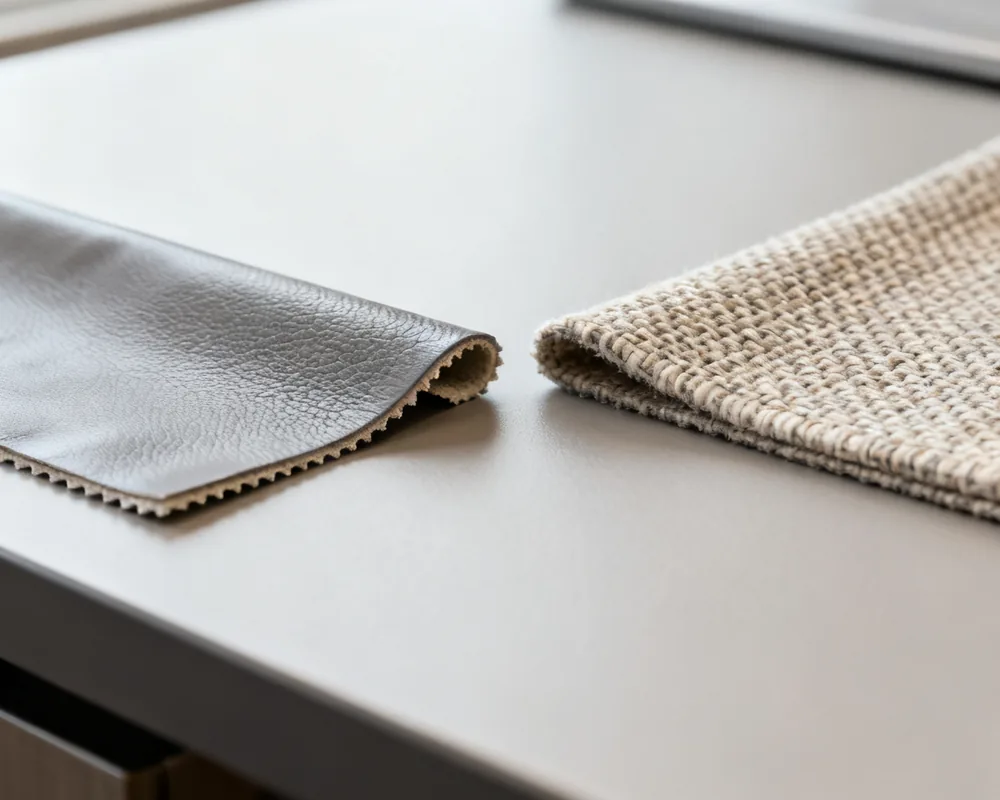
A marine upholstery vinyl is often chosen because the face can be wiped and the grain can be matched across cushions. That choice still needs a construction note. Some specimens are a coated face on a textile backing. Others are discussed as a laminate. The words are not interchangeable. Ask which layers are present, how they are joined, and which layer the cleaner or the stitch actually touches. A collection name does not answer the layer question.
If someone attaches an environmental sentence to Apex, Allegro, or another Spradling marine vinyl name, read the holder and the product scope before repeating it. A statement about one input polymer, one plant, or one lot does not automatically cover every color and backing. Recycled-content wording, if it appears in a document, needs the declared percentage basis and the chain step it refers to. This site does not supply that document and does not invent one.
Textile alternatives in the same seat
A woven or knitted upholstery cloth can be the comparison material when the buyer wants a different handle or a different care cycle. Touch, drying, and seam bulk will not line up with vinyl just because both cover a cushion. Review strength, stretch, and cleaning in the marine setting you named, and keep outdoor exposure separate from cabin use. Natural-fiber comfort arguments and synthetic drying arguments both need the actual cloth, not a general ranking.
End-of-use routes are easy to overstate. A coated fabric with a blended backing may not follow the same recovery path as an uncoated cloth. Say which route exists for the construction in front of you. If the route is unknown, leave it as a question. Do not convert a design preference into a claim that the cushion, the boat, or the brand has a measured environmental outcome.
Avoid a single environmental ranking
| Dimension |
Question |
| Material source |
What polymer, cloth, or backing does the declaration name? |
| Processing |
Which coating, lamination, or dyeing steps are inside the statement? |
| Use and care |
What cleaner, rinse, and exposure does the seat actually see? |
| End-of-use route |
Which recovery or disposal path is documented for this construction? |
Tradeoff language is a way to keep the marine decision honest. Vinyl may win on wipe-down and grain consistency while a cloth wins on handle or breathability in a shaded cabin. Neither result is a universal score, and neither should be copied from a different industry category such as apparel or hygiene nonwovens. Bring the specimen, the care routine, and any source document to the enquiry if those points decide the shortlist.